
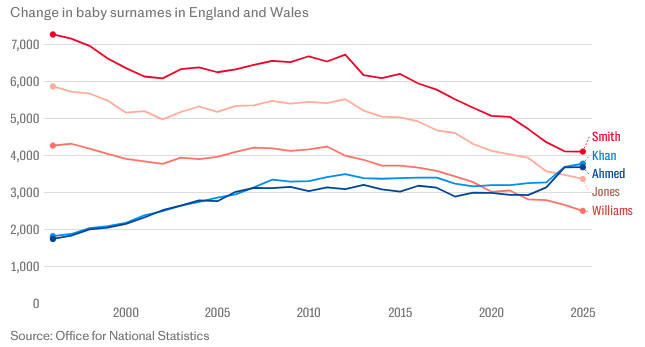
Traditional British family names are losing ground as Khan closes in on Smith, with changing immigration patterns and falling birth rates among UK-born mothers reshaping the names given to the next generation.
Just 330 births separated Smith and Khan in England and Wales last year, putting one of Britain’s most familiar surnames at risk of losing its long-standing position at the top of the newborn rankings.
An analysis of official figures suggests Khan could become the most common surname among babies as soon as 2027. The name, widely used in South Asian countries, has more than doubled in popularity over the past three decades, while Smith has experienced a sustained decline.
The figures highlight a significant change in the surnames carried by the next generation, with traditionally British names increasingly competing with those associated with communities that have grown through migration.
Smith’s lead has almost disappeared
Smith remained ahead of Khan in 2025, with 4,102 babies registered under the surname compared with 3,772 for Khan.
However, the direction of travel points towards a potential change at the top. Smith has been declining by an average of 4 per cent a year, while Khan has been increasing by an average of 1.9 per cent annually.
If those trends continue, Khan is projected to overtake Smith in 2027. The figures do not establish that the change is inevitable, but the gap between the two names has narrowed dramatically.
In 1996, Smith was ahead of Khan by 5,464 babies. By 2025, that advantage had shrunk to just 330.
Traditional British surnames lose ground
The changing fortunes of Smith reflect a wider shift across the most popular surnames given to newborns.
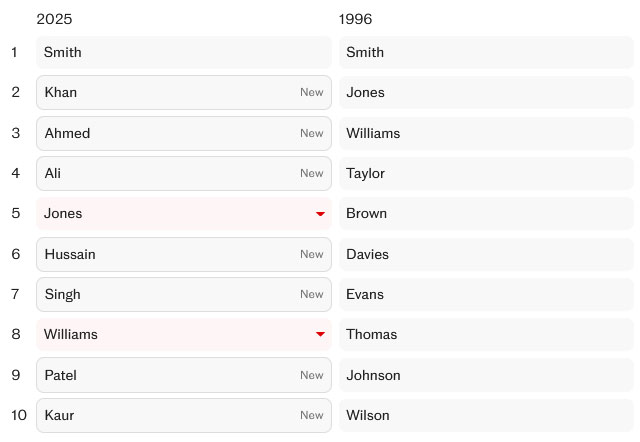
In 1996, all ten names at the top of the rankings were of established British origin. Smith, Jones and Williams occupied the first three positions.
By 2025, only three of the top ten surnames came from that background. Khan, Ahmed, Singh and Hussein had risen into the leading group.
Several historically popular British surnames have also recorded substantial declines since 1996:
- Long: Down 55 per cent.
- Potter: Down 54 per cent.
- Carr: Down 52 per cent.
- Hammond: Down 52 per cent.
- Jones: Down 43 per cent.
- Williams: Down 41 per cent.
Smith itself has fallen by 44 per cent over the same period, underlining the scale of the change in the names being passed on to newborns.
Immigration and birth rates reshape the figures
The changing rankings reflect several demographic factors, according to researchers at the University of Oxford’s Migration Observatory.
Nuni Jorgensen, a researcher at the organisation, said immigration from South Asian countries had increased in recent years, particularly since 2021. She also pointed to differences in birth rates between UK-born women and migrant mothers.
Since 2008, the number of babies born to British-born mothers has fallen by 29 per cent. Over the same period, births to foreign-born mothers have increased by 18 per cent, including a 41 per cent rise among mothers born in Asia and the Middle East.
Jorgensen also highlighted the effect of surname distribution. Some communities use a smaller pool of surnames more frequently, which can increase the prominence of individual names in birth statistics.
However, she cautioned that there was insufficient data to establish precisely how much this factor explained the relative popularity of Khan and Smith.
Muhammad also tops the boys’ rankings
The surname figures follow a similar change in the rankings for first names.
Muhammad became the most popular boys’ first name in England and Wales in 2023, when more than 4,600 babies were registered with that spelling. The name retained its position at the top in both 2024 and 2025.
Other spellings, including Mohammed and Mohammad, also featured among the 100 most popular boys’ names.
Together, the first-name and surname figures illustrate how the names given to newborns have changed alongside the country’s demographic composition.
Experts disagree on the meaning of the shift
Sunder Katwala, director of the British Future think tank, argued that the growing diversity of surnames should be viewed in the context of children sharing schools and communities.
He said: “Britain is becoming more diverse. These new Smiths and Khans will all go to school together in a few years, alongside children with many other surnames. The question isn’t really whether Khans outnumber Smiths or vice-versa: it’s how to ensure that they, and all of us, can live together well.”
“It’s a change inflicted upon the country with no democratic mandate”
Rob Bates, research director of the Centre for Migration Control
Rob Bates, research director of the Centre for Migration Control, took a sharply different view, linking the changing demographic picture to successive governments’ immigration policies.
A critic of those policies, Bates argued that ministers had failed to respond to public concerns about immigration.
He said the changes reflected what he described as “unprecedented demographic change” over a relatively short period.
The shift reverses a centuries-old pattern
Smith’s position at the top of England’s surname rankings has deep historical roots. An estimate from 1853 put the number of people named Smith in England at 253,600, making it the country’s most common surname at the time, ahead of Jones and Williams.
The latest figures suggest that the pattern could be approaching a turning point among newborns, even though Smith remains ahead of Khan in the current data.
The broader figures also show how changes in migration and the number of births to different groups of mothers can influence the rankings from one generation to the next.
Whether Khan takes the lead in 2027 will depend on how the trends develop. For now, the narrowing gap offers a striking indication of how dramatically the surnames of England and Wales’ newest generation have changed.